


 Cart
Cart
 sales@molnova.com


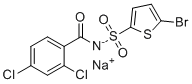
Tasisulam sodium
CAS No. 519055-63-1
Tasisulam sodium( LY 573636 sodium )
Catalog No. M14818 CAS No. 519055-63-1
Tasisulam (LY 573636) is a small molecule antitumor agent that induces apoptosis via the intrinsic pathway.
Purity : >98% (HPLC)
 COA
Datasheet
HNMR
HPLC
MSDS
Handing Instructions
COA
Datasheet
HNMR
HPLC
MSDS
Handing Instructions
| Size | Price / USD | Stock | Quantity |
| 5MG | 873 | Get Quote |


|
| 100MG | Get Quote | Get Quote |
|
| 200MG | Get Quote | Get Quote |
|
| 500MG | Get Quote | Get Quote |
|
| 1G | Get Quote | Get Quote |
|
Biological Information
-
Product NameTasisulam sodium
-
NoteResearch use only, not for human use.
-
Brief DescriptionTasisulam (LY 573636) is a small molecule antitumor agent that induces apoptosis via the intrinsic pathway.
-
DescriptionTasisulam (LY 573636) is a small molecule antitumor agent that induces apoptosis via the intrinsic pathway, resulting in cytochrome c release and caspase-dependent cell death; shows antiproliferative effect against a variety of human hematopoietic malignancies, including AML, B-ALL, large B-cell and mantle cell lymphoma cell lines; promotes the recruitment of RBM39 to the CUL4-DCAF15 E3 ubiquitin ligase, leading to RBM39 polyubiquitination and proteasomal degradation; causes aberrant pre-mRNA splicing.Blood Cancer Phase 1 Discontinued.
-
In VitroTasisulam sodium (200 nM-200 μM; 48 hours) induces an antiproliferative response across a wide range of tumor histologies with EC50s of 10 μM and 25 μM for Calu-6 and A-375 cell lines, respectively. Tasisulam sodium (25, 50 μM; 72 hours) induces a concentration-dependent increase in 4N DNA and G2-M accumulation. Tasisulam sodium (200 nM-200 μM; 48 hours) induces apoptosis in a broad range of in vitro cancer cell models. Tasisulam sodium also blocks VEGF, epidermal growth factor, and fibroblast growth factor-induced endothelial cell cord formation.Cell Proliferation Assay Cell Line:Calu-6 non-small cell lung carcinoma and A-375 melanoma models Concentration:200 nM-200 μMIncubation Time:48 hours Result:Induced an antiproliferative response across a wide range of tumor histologies with EC50s is 10 μM and 25 μM, respectively.Cell Cycle Analysis Cell Line:Calu-6 and A-375 cell lines Concentration:25, 50 μM Incubation Time:72 hours Result:Induced a concentration-dependent increase in 4N DNA and G2-M accumulation.Apoptosis Analysis Cell Line:Calu-6 non-small cell lung carcinoma and A-375 melanoma models Concentration:200 nM-200 μM Incubation Time:48 hours Result:Induced apoptosis in a broad range of in vitro cancer cell models.
-
In Vivo——
-
SynonymsLY 573636 sodium
-
PathwayProteasome/Ubiquitin
-
TargetE3 Ubiquitin Ligase
-
RecptorE3 Ubiquitin Ligase
-
Research AreaCancer
-
IndicationBlood cancer
Chemical Information
-
CAS Number519055-63-1
-
Formula Weight437.09
-
Molecular FormulaC11H5BrCl2NNaO3S2
-
Purity>98% (HPLC)
-
Solubility——
-
SMILESC1=CC(=C(C=C1Cl)Cl)C(=O)[N-]S(=O)(=O)C2=CC=C(S2)Br.[Na+]
-
Chemical NameN-[(5-bromo-2-thienyl)sulfonyl]-2,4-dichloro-benzamide sodium salt
Shipping & Storage Information
-
Storage(-20℃)
-
ShippingWith Ice Pack
-
Stability≥ 2 years
Reference
1. Meier T, et al. Mol Cancer Ther. 2011 Nov;10(11):2168-78.
2. Haritunians T, et al. Oncol Rep. 2008 Nov;20(5):1237-42.
3. Han T, et al. Science. 2017 Apr 28;356(6336). pii: eaal3755.
molnova catalog



related products
-
cIAP1 E3 ligase inhi...
cIAP1 E3 ligase inhibitor D19-14 (cIAP1 inhibitor D19-14) is an improved analog of D19, demonstrates significantly increased ability to inhibit cIAP1 autoubiquitination and reduce protein levels of c-MYC in vitro.
-
HOIPIN-8
HOIPIN-8 (HOIP inhibitor-8) is a potent chemical inhibitor of linear ubiquitin chain assembly complex (LUBAC, IC50=11 nM).
-
PRT-4165
PRT-4165 is a potent inhibitor of PRC1-mediated H2A ubiquitylation.
